Showing posts with label shirt print. Show all posts

Friday, March 27, 2026

Athletic numbering in the digital age

 Today's athletic number solution

DTF has taken over athletic printing.  This is the easiest way to customize a team, sponsor, name and number onto any jersey.  Just load, scan and press GO.  The Yet-Tee does it all.


The early years.

Brown Manufacturing is known for leading the athletic numbering machinery world for decades.  We developed patented technology for high volume direct print numbers with the NumberPrinter.  

We created simple machines for community printers who decorated leagues for only a few months in the year.  The Slider and the ShortStop were compact and simple to use.  

We offered a wide array of number fonts that were available for both the NumberPrinter and the Slider.  

However, while all this is still available, it has been replaced with the advancement of digital printing technology.  

There are many digital options.  The world of sublimation has taken over many sports.  Lacrosse and basketball are large consumers of sublimated uniforms.  DTG has also been effective for many teams.  That technology prints well on non-polyester items and allows for individualization.  And while heat transfer numbers have been available for decades, no athlete liked to wear them.

That is until the development of DTF.  The ink and application advancements within the last 5 years have changed the feel and weight of the final image on the garment.  The diversity of fabric adhesion gives a wide array of application possibilities.  And with the development of DTF digital printers, personalization is simple.  However, until now it has had a high labor and COGS element.

Printing, cutting and sorting of films and garments involves a lot of labor time.  And, as all community printers are aware, leagues do not offer great margins in what they can be charged.  Controlling costs time and materials is essential. 

Today's tech

Brown Manufacturing's  Stomper Yet-Tee automated DTF system requires only that the operator load the garment and scan a bar code.  The finished jersey with an individualized number, name and logo is returned to that same operator complete and ready to ship.

The Yet-Tee T-Line and L-Line systems include a DTF printer, power shaker, cure unit, Flipper placer and heat press.  Larger units feature multiple heat presses and a peel unit.  Art for each garment is specified within the barcode that the operator scans and that art is printed and placed into position onto the jersey.  The jersey is pressed and peeled and post-pressed and returned to the load zone.  Full customization in minimal time.  As an added bonus, the feel of the jersey is similar to the feel of screen print.

Why would an athletic printer still offer anything else?


Tuesday, March 18, 2025

DTF Production Systems


DTF Production

The garment decorating industry is at an accelerated pace for new technology and revitalization thru modification of old technology.  DTG launched the POD landscape that is now offered thru all levels of the supply chain.  Behemoth producers like Amazon and small community printers are adding POD tools to their production facilities to meet the consumer demand.  

The presentation of DTF into the production floor is not new, as all facilities have used transfers for decades.  However with the updated digital printing of these transfers this process has shifted many facilities to needing high volume DTF systems to fulfill orders.  

Brown Manufacturing offers 3 options for high speed DTF that will increase the speed of bulk orders with minimal labor costs. 

MasterPress

Level 1

The MasterPress is a base unit that features 2 heat presses and 5 shirt stations.  This allows 2 operators to load, press and peel in a small footprint.  Featuring a simple control panel and independent, adjustable temperature and pressure for the heat presses, this is a lower cost alternative for speed for the bulk DTF production.

Simple 120V power supply and a small air compressor is all this unit requires to quickly become operation in any shop.  Just map out spot on your floor and plug it in.

Level 2

If labor reduction is part of your production requirement, then the need for speed and accessories will move your shop to the next level.  Flexibility in design and additional options will amp up the production and reduce the operation to one person.

This heavy duty press comes with one heat press but has an option for two.  It also has these options:
  • Automatic feed system
  • Automatic peel system
  • DTG pretreat sprayer system
With one press, an auto feeder and an auto peel, the operator is only loading shirts.  With a larger unit, add a 2nd operator and the speed increases with one shirt load person and one shirt unload.  

Level 3

Design your own system for exactly the flexibility your shop needs.  This level allow the system to both DTF and screen print.  Add print heads, loaders, peeler, multiple heat presses, flash units and DTG pretreat sprayers all on the same system.  No matter the job needed, one machine will have the tools.

DTF Print and press
Which one is right for your production needs?  Contact our Brown sales team to plan out your improved production facility or call 616-249-0200 for immediate information.

Friday, October 25, 2024

Essential tools for POD profitability

Print on Demand is changing the industry

With the rapidly growing demand for individualized prints, social media driven trendy garments and next day delivery, the nimbleness of every garment decorator is being tested.  The advancement of DTG and DTF production technology has improved the response time for web driven orders.  New machinery like the Brother International Digital Line which integrates POD and reduces labor, are becoming more and more essential. A vital issue to stay profitable in this fast changing environment is internal work flow management.  Paper orders on the shop floor have got to go.


DL-2400 Digital Line


BrownDigital Linx Production Software Suite

In a previous blog Linx, we explained how Linx pulls orders directly from web stores and feeds those orders to production machinery with automated tools.  The Linx Software suite has expanded to include cloud based inventory management, purchasing and product creation.  Additional features within this software packages add a depth of resources to the constant changes that occurring in this market space.
  • Product Creator and Product fixer will merge all store products into one application for production an inventory management
  • Build-to-Stock (BTS) pushes stock inventory builds, manages returns for FIFO control, and gives full control to the production manager to keep within seasonal cycles.
  • Order Submission provides an access point for POS
  • Cloud management of floor production
  • Analytics of real-time floor production

Is this only for garment printing?

The answer to that is a firm NO.  POD is a market trend that applies to many products.  Garments are the highest volume however these issues apply to any one-off customized item.  Linx Software suite can connect to laser engravers, sublimation systems, embroidery stations, cutters and plotters and many other tools of the trade.  In addition to garments, the inventory management is open to any base product such as trophies, mugs, plaques, posters and many more.  

Linx Software suite connects to any open API platform.  This includes Etsy, Shopify, Shipstation, Amazon, and many more.  Contact BrownDigital today for additional information of how Linx Software suite can improve your work flow.


Monday, October 7, 2024

ElectraPrint BP introduction

 You asked for a 12 station ElectraPrint!

ElectraPrint BP 10 color 12 station


The ElectrPrint series machines has been a perfect fit for community printers for many years.  Starting with the Junior and the Stealth machines, Brown has delivered low maintenance high quality production machines to shops all over the world.  Many of our customers have requested we expand the line to allow more colors.

The BP series is available in 8, 10 and 12 station machines in both the Junior and the Stealth machine sizes.  This allows for more colors in small spaces, with the Junior.  And for larger prints using the Stealth.

The BP series provides all the features you have come to expect from the ElectraPrint line of machines.    This machine is fully electric with easy to understand controls.  iMade is a standard feature as well as skippy platen sensor and flash ports on every head.  

The LazerLoad feature, the Set-N-Go and the QuartzAir Flash are all available options for this machine as well as a wealth of different platen sizes.  

For more information on how this fits into your production space, contact your Brown Team or give us a call 616-249-0200.


Friday, April 21, 2023

For Brown, it is all about customer service

When a person calls Brown Mfg they get a person.  We do not use automated attendants or voice mail on our main phone system.  When someone sends an email to what appears to be a generic email address such as sales@brownmfg.net or customerservice@brownmfg.net or linx@brownmfg.net those emails land directly in a person's inbox so they can be addressed quickly and directly.  These corporate choices are based on the elemental belief that direct person-to-person interaction provides the highest quality service to our customer.  Call us old fashioned, but we get thank you comments from our customers on a daily basis.

Another customer service item that we offer is custom paint as an option for new machinery purchases.  This generates excitement for people who have their machinery as part of their customer's experience.  These businesses sometimes have a production shop as a showroom and they have a corporate color scheme to match.  Recent colors have included combat green for a customer who services military families, hot pink for an all women's shop, and red white and blue because,  well, just because.  

One added benefit item we offer is creative installation solutions.  We cater to community printers. These are typically businesses with very limited space and often owner/operators of the machinery they buy.  Their production spaces are often not commercial, do not have loading docks and many times are multi storied.  One ElectraPrint leaving this week is no exception.  This installation involves a set of stairs into a lower level with 36" doorways.  

To accomplish this task, we take the machine apart into manageable pieces.  The base, the print hub and the platen hub are all packed separately.  The heads, platen arms and accessories are on other pallets.  

Our installer has tools available to assist with moving these pieces into tough spaces and to reassemble these pieces in the final location.  Once assembled, the installer will continue with the standard installation process and training of the customer.  


Yes, this is a fun one.  But not unique.  We have many stories of fun installs.

So, if you are thinking that it is time for your shop to step up into an automatic press but you are concerned about how it will fit into your space, contact us.  Brown has solutions.  We also have over 50 years of experience at these creative installations.  We are here to assist you, person-to-person, in making your business more productive and more profitable.


Monday, August 8, 2022

Innovation Center at Brother International


It has been a long time coming and the Brown staff is excited to see that their hard work has paid off.  Brother International opened a new training facility at their Bartlett, TN location and the BrownDigital product line took center stage.  

This new product line has been under wraps for 2 years.  A single operator loads a garment and these garments are pretreated and digitally printed and returned to the same operator.  One guy does it all.  Amazing.

Thank you to Brother International for the opportunity.

Wednesday, January 5, 2022

POD production? It's where the world is.

Our roller coaster world has made traditional printing businesses  take another look on how they generate orders.  When schools and restaurants were closed, many of our community printers had to consider other avenues for revenue generation.  The world of online shopping became essential for all decorators, whether one off orders or bulk.  These orders can be challenging to pull into standard community printing production management.  

The old school paper production tickets are messy and confusing for small orders.  Barcode systems that can function for both small and bulk orders are cleaner and more efficient than sheets of paper floating around a production floor.  Scanners at each workstation can pull up all order details within seconds and connect directly with shipping software.  With Linx Production software, the barcode will also drive the printers, laser engravers and sublimation systems.  

Wait, what?  It can connect my online to my production machine and back to my shipping software?

Yes, Linx Production software can do all that and with additional modules it can connect to QuickBooks® and manage inventory and purchasing and print bulk orders.  That is a lot of features that every shop needs in the world of POD.  

While much of the US is opened back up schools, businesses and events, the online store is now a required element to a business.  Many businesses who used to allow sales people in their doors are now preferring to look online and connect through teleconference platforms.  These options allow higher time flexibility for the buyer and keeps additional people out of their workspace.  With the latest variant wave, this is a required element.

So how does Linx Production software do all that?

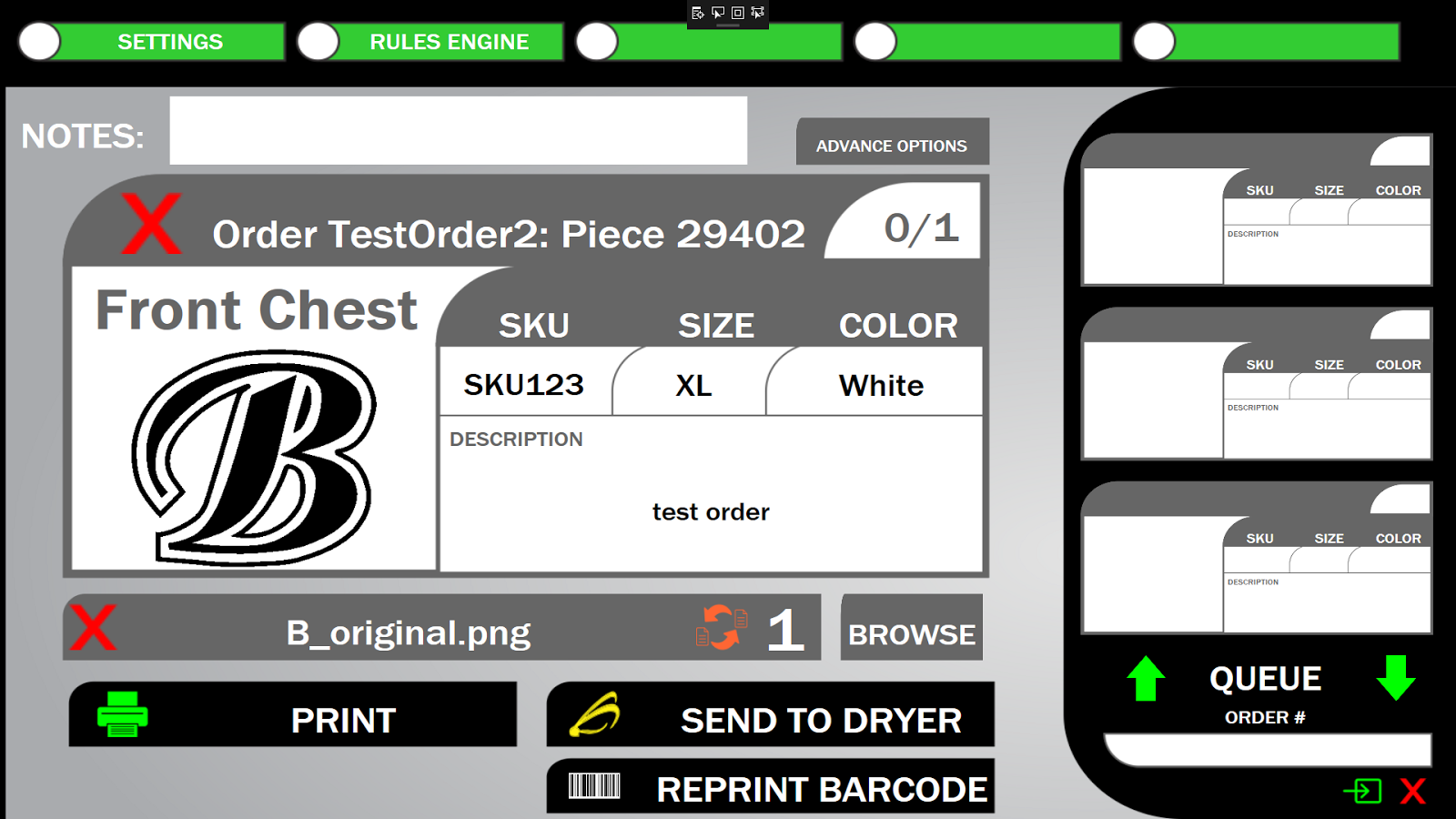
Beginning at a web store, information for an order is pulled into Linx and a barcode is assigned. This information includes garment data as well as art and print locations. The PNG artwork is ripped for the DTG as well as scaled for garment size and print location. For other print mediums, the art is converted to match the requirements of the output device.  The operator loads the item, scans the code and the output device has all the information needed for production. Print specifications are preset by the user as well as pretreat and cure requirements.

Orders can be sorted by all major factors. This aids in purchasing, product picking, pretreat scheduling and customer management. At shipping, a binning system allows for gathering of multiple items of an order with notifications when an order is complete. In the QC department, if a product does not pass inspection, the barcode returns to th production schedule for a reprint.


A QuickBook plug in will also connect your orders directly to your billing department. Inventory modules are available for small and large users.  Custom API connections are available to give full flexibility to your production needs.

How do you  get started?

Lins Production Software
Call BrownDigital today for information on pricing and how this system can be used in  your shop.  It is quick to install, simple to learn and will speed up order processing for small or bulk orders.


Friday, August 13, 2021

So many decorating options.


Brown did some recent DTG print testing and I had some thoughts.  This particular test involved a print run of about 72 shirts ranging from youth medium to adult 3xl.  It has a white crest print and a multi-color full back on a dark shirt.  A typical order for a community printer.  And a profitable one if handled correctly for your shop.  

What is correctly?

DTG

This run was done with a digital printer and our Synergy pretreat and FireFly cure systems.  At 72 shirts with a white under-base, this job took almost 2 hours.  The image quality was fine but it did look like a digital print. They are clean but they do not pop.  The estimate on the cost of each garment includes time and materials.

Shirt $2
Ink $0.95
Pretreat $0.30
Shop time cost  $1.66
Labor $0.83

Total cost per shirt $5.74     

The positive to DTG  printing is that once the art is approved there is no additional processing of the art to print.  A quick conversation from the PNG and it is ready.  Also, employee training is minimal.  Everything is determined by the Linx program within the machines and the operator only loads and unloads.  Additionally, the software will resize the art to the size of the garment, the job is easily repeatable and there is no clean up at the end.


Screen Print on an automatic

So, what would happen if it were printed on an ElectraPrint auto press?  Front and back, this job would be finished in less than an hour.  The look would be crisp and it would pop off the shirt.  The size of the print on the youth would be the same size as on the 3XL, which is a negative.  There is set up and clean up.  The art needs to be separated and screens need to be made.  Presuming that this design could be printed with 6 colors, this is the estimated cost per garment.

Shirt $2
Ink $0.06
Films/screens $0.08
Shop time cost $0.83
Labor $0.42

Total cost per shirt $3.31


Screen Print on an manual

So, what would happen if it were printed on an MasterPrinter manual press?  Front and back, this job would be finished in about 2 hours.  The look would be crisp and it would pop off the shirt.  The size of the print on the youth would be the same size as on the 3XL, which is a negative.  There is set up and clean up.  The art needs to be separated and screens need to be made.  Presuming that this design could be printed with 6 colors, this is the estimated cost per garment.

Shirt $2
Ink $0.06
Films/screens $0.08
Shop time cost $1.66
Labor $0.83

Total cost per shirt $4.63 

Is cost the only factor in the production path?

Well, we can all say "no" to that answer.   But there is $2.50 per shirt here in profit.  So COGS cannot be ignored.

COGS is a significant factor.  That calculation has to include machine time, shop time and labor time.  However, judging the flow of your shop, the availability of your staff and their skill sets, and the print preferences of the final customer will sway the final production decision.   If they want "pop" then they will want screen print.  If they prefer a soft feel, then DTG is a good plan.

So the real answer is that there is not a "correct" way to do this except to follow some basic guidelines.

  1. Is the customer happy with the finished product?
  2. Did you deliver on time?
  3. Did you make a profit margin that you would want repeat the job?
  4. Did this job delay other jobs that were more profitable?
If your answers are yes, yes, yes and no, then you have chosen wisely within the parameters of your production facility.  If any other answer comes up, then reconsider for future jobs what needs to shift.  Was the print accepted, was job late, or did you not make enough of a profit margin?  Because in the end, it is a happy customer with a solid bottom line that we are all striving to achieve.


Thursday, May 20, 2021

When to update to new stuff?

Tech changes every day.  Our fast paced world is presenting us with new, and better, ways to accomplish most things on an hourly basis.  Some of this is very intriguing such as electric vehicles or 3D printers.  I do get annoyed, however, being told that I have peeled a carrot wrong my whole life and this new hack or tool will be the only answer.  And though I am sure that my carrot peeling skills are just fine, at what point does the machinery in my shop need to upgrade?  When is the new really better than the old?

What can the new tech do?

If the new gadget is cooler looking than the old one you might be inclined to switch.  Aesthetics in an automobile are important.  We all like new, shiny things.  However there are certain requirements that make a new device worth adding to a shop.

  • does it make a process faster?
  • does it reduce costs?
  • does it make a final product better?
  • does use less floor space for the same results?
  • does it require less power for the same production?
  • is it easier to use?
There could be more to the list, but the idea is that a new gadget needs to improve production either with cost or quality or time.  If it does not do any of these things, just wait.  Another version will.

What does the new tech NOT do?

Yes that is important.  If the new item does go faster or reduce costs but it makes an inferior product it is probably not worth the investment.  If it goes faster and makes a great product but the cost makes the RIO low, then it is not worth the financial outlay.  If it does not do all the steps in production that the current version can do, then this is not a gain.  New is not always better.

When should the old tech go, no matter what?

I say that with some wisdom.  As a manufacturing company who has produced machinery since 1979, we help people every day fix stuff.  We offer free phone service and with the use of digital photos, Zoom and FaceTime we are able to fix most old machines.  Many times that repair is priced quite reasonable and the customer keeps using a machine from the 80's.  

However, sometimes old is old.  Broken is broken.  And being thrifty (read cheap) does NOT help your bottom line.  Maybe you can get the parts for a 1984 machine.  However, how long were you down waiting for them?  How long did you have to search for a supplier for them?  Are they the direct replacement or did you have to modify the machine to make them work?  All of those items cost money.  Down time means late production.  Your search time means you did not spend time making sales or managing your production.  Modifications to old stuff takes both your time and down time and they are never quite what you needed.  Is that cost beneficial?

We do understand small business and the need to keep costs down.  We understand budgets.  We also know that if you have big equipment with big repair bills you have a hard time paying, then your really needed smaller equipment to suit your space and revenue.  Crunch those numbers sometime.  You might be surprised to find out that that big stuff you bought at a great price is costing you more than you make and newer smaller stuff would make you more profitable.  Hard to fathom sometimes but it is true.

How can we help you figure it out?

Most people do not like to discuss financial situations with sales people.  But the truth is, good sales people want to see their customers succeed and make money.  Think about your own style.  You want to have return business and you treat a customer with the goal of seeing them again.  Capital goods sales people are the same.  We would like you to buy well so you do well.  Then call us again for the next cool tech item that you are interested in.  So consider sales people as allies who gain when you gain.  Ask them if it is worth it to keep with what you have or go new.  Yes they will pitch new as hard as they can.  They have kids to feed, just like you.  But good ones will help crank the numbers to see if the justification is there for your shop.

You might be surprised by what you learn.

Wednesday, March 17, 2021

Start your engines. The season is about to begin.

 Are you ready?

The season is about to begin.  It has been a long time coming but it is finally here.  Are you ready?

What exactly does that mean?  Are your machines ready for all the action about to happen?  Let's go over what you should be doing now so you are ready for all the orders that are coming your way.

Check under the hood.

Conveyor ovens

Your curing system is the most important machine in the building.  You can print in any number of ways.  But getting a shirt cured has limited resources.  So keep your conveyor ovens at optimal performance levels.  How do you do that?
  • Clean it.  Yes, it is the most important thing.  Get all the fuzz off of it and out of the control panel and fan systems.  The biggest reason for oven failure is overheating due to lint build up and fan functionality.  So get out the shop vac, open the control panel and clean it out.
  • Replace stuff.  We understand that in low times, the cost of replacement parts can seem prohibitive. However, if you are down during the busy times due to lack of maintenance, the cost to the business is higher.  Cooling fans, old drive motors and dirty or torn conveyor belts are quick to change and will reduce down time during high volume months.
  • Have commons part parts on hand.  Some items are low cost and quick change.  Having these items on hand will lower any downtime. Relays, heater connectors, fans and fuses are small and inexpensive.  These are highly recommended to stock on your shelf.
  • Check out the drive system.  Worn sprockets and chains will cause power spikes that will damage a motor control.  This will double your replacement cost.

Automatic printer

Unless you want to manually pull a squeegee on the long run you have, you should spend a little time making sure that your Electraprint is running well.  There is a reason that it asks every time it turns on, "Have your greased me today".  It is important that all the moving parts on the machine have lithium grease applied and lint removed.  This includes squeegee carriages, head side rails, cheese wheels and lift mechanisms.  There are a few other items on the press to check.
  • Squeegees and floodbars need to be sharp and smooth.  No nicks or dull edges.  
  • Have some extra squeegees because color changes just slow you down.  A squeegee for each color group is a great investment.
  • Platens are clean and the rubber coating doesn't have bubbles or tears.  A great print happens on a flat, smooth surface.  Don't skip on the basics.
  • Chains and motors and sprockets do wear.  These are what drive the print heads.  Check now while you have time for a sprocket change.
  • Clean it up.  Seriously, clean shirts come off clean printers.  And it is the cheapest way to keep a press run smoothly.

What should be in on your parts shelf in case of a pit stop?

Each machine has some essential items that cannot be bypassed.  And many of these are inexpensive so having them immediately available is like having a spare set of tires ready when the car rolls into the pit.

Dryers

This is all about moving electricity.  Simple parts will keep an oven rolling until bigger items can arrive.  
  • Fuses or panel breakers
  • Power breakers
  • Relays
  • Terminal blocks for older heat chambers

ElectraPrint Automatics

  • Photo eyes -- there are a couple of types, so have one of each
  • Safety switches
  • Flash controls
  • Head cable set

What tools are needed for the pit stops.

It surprises us often that many of our customers own industrial equipment but do not think to have a basic tool box anywhere in their shop.  This does not need to be an extensive set of tools, but some basics are needed to keep a shop rolling through a pit stop.
  • Open end wrench set
  • Socket set 
  • Screwdriver set
  • Nut driver with 1/4" socket
  • Basic multi meter.  Our phone techs can teach you to use one, but they are really handy when working on anything electrical.

So get ready to race.

Order some inks, get your screens stripped and coated and set out your print stations.  There is business in the air and the race to the finish will be a wild one.  Let's not have any crashes into the wall.  We will all get to the finish line.  


Monday, February 24, 2020

Set-n-Go. Go where? No, go faster.


Every manufacturer of printing equipment touts a pre-registration system.  This is not one of those "do you want fries with this" kind of items.  It is a serious tool and we think that it is a necessary piece of equipment whether you are printing manually or on an automatic.  Old school printers and many do-it-yourselfers will say that this is unnecessary because they are so fast in set up, but experts disagree.  These systems have gotten so elaborate that you can purchase printers to put the art exactly on a screen so that press registration upon set up is perfect.  These high end systems would not be developed if they did not have major benefits that offset the costs.  They will cut your screen set up time on a multi-color job down to 5 minutes.

Time is money

Speed and accuracy, my friend.  Speed and accuracy.  Hypothetically, if artwork were always placed in the exact same spot.  If screens were loaded into the press in the exact same spot.  If artists registered the art to the final garment each time.  Then job set up would be so perfect that press adjustments would not happen.  Imagine the speed.
  • Little to no micro or macro adjustment of the press
  • no platen adjustment
  • no checking of the artwork location on the garment and adjusting to fit
  • straight prints all the time without hassle
Yes, some of you will say that you never do any of these things.  Seriously, we know you do.  That is why we put all of these adjustments on a press.  However, we know that all of these adjustments will cause set up for every multi-color job to be a minimum of 15 minutes.  

How does it help?

By starting back at the art department, a set of predefined art locations will cause the artwork to land on the correct location on each garment without adjusting the platen or the garment upon load.  


If the Horizon line of your artwork represents the collar of the garment, the the artist has a good starting point of knowing where to place the art.  General rule is that there is a 3" gap between the collar and the top of the art.  Also, if the Horizon line is also the top edge of the platen on the press, then you can say that all garments load so that the collar just falls off the platen.  If the artist and the printer match, then the operator only needs to load the screens a to the preset stops and the platen will not need adjustment.  This is the same for all art locations.  Preset the location of the pocket or the back print and allow the collar to always just fall off the shirt board.  This simple rule of preregistration systems saves time on every job.  No more guessing of platen location.  No testing of shirt load location.  No wondering this run will match the previous run of the same job.

How do you get the screens exposed correctly.  

Let's think through the next steps of the process.  The artwork comes from the art room with horizon lines and registration marks on each film.  The platens are fixed in location.  Now if every screen is burned using a fixture that matches a fixture on press, then set up is a breeze.  And by fixture, we do not mean a t-square.  We are looking to speed things up, not slow them down.

The screens go on a jig, the art matches the jig.  Process the screens and then load them against the jig that is on the press.  Sounds clean and simple, right?  Ok, let's slow this down and list this out.  The artwork is set against a standard registration template so that template should be affixed to the screen box.  In some systems, there are pins that the artwork sits on.  In some, the fixtures are on the exposure glass.  In ours, the template is adhered to the yellow box.  The screen seats agains the guide pins and then the art is taped on while matching the template.

Once the screen has been processed, the screen is set into the press against a guide pin bracket.  This bracket flips down so that it stays on the press but is out of the way of the operator.  Check out this video for a quick "how it's done".


Yes there will be some short term time spent on learning new steps.  However, if the press set up time drops to under 5 minutes, then the value of the system is justified.  The faster we move a job through the shop the higher the profits.

Thursday, August 29, 2019

Preparing for new equipment installation

Growth and expansion in a business is driven by the arrival or hope of new customers and orders.  This justifies the cost of new equipment in all levels, whether a new exposure system that allows for faster screen production, a new DTG to expand into new markets or a new automatic press for quicker turn around.  This expansion is exciting and trying times and there are some tips for preparation of installation of the new equipment.

What to expect upon machinery arrival.

Depending upon what is coming, a machine may be installed by your own staff or it may need a technician.  However, one this is certain.  It will arrive on a truck and it will be heavy.  It will need planning for the unload and connection.  What exactly does that mean ?  It means understanding how to get the product off the truck, having a door and path wide enough for the equipment to reach its final location, having utilities and services ready and finally having people on hand to help.


If it is coming on a commercial carrier.

Common carriers, those are the semi-trucks seen on the road, then accommodations need to be made to get the machinery off of the dock high truck and onto your production floor.  If your location has a dock, then a pallet-jack is typically sufficient to unload from the truck.  If your location does not have a dock, then there are a couple of options.  First, a lift gate can be requested.  These are an additional cost and additional delivery time.  Also, if the crate is larger than a 4' x 4' area, then a lift gate will not be large enough to handle the skid.  Second, a fork truck can be rented and the crates can be lifted from the back of the truck to the ground.  This rental is typically the same cost as a lift gate.  As a final option, a roll back tow truck can meet the carrier and move the crate onto their bed and then lower it to the ground.  This is typically economical and most roll back drivers are trained in this process.


Once the crate is in the shop, equipment must be available to remove the equipment from the crate.  This will require people or a fork truck.  Smaller machinery can often be lifted with a few people but anything like an embroidery machine or an automatic press will require a fork truck to place the machine into position.


If it is being delivered by the manufacturer or distributor.

Typically, a driver for a manufacturer or distributor will have a plan for getting machinery to the ground and often a plan for placing it into position.  However, that installer will need people to help.  One person cannot move machinery without additional muscle.


What should be ready at your location?

An installers time is limited, so to get the best use of that time the shop should be completely ready for the product to install.  This means that in addition to having a way to move the machinery from the truck to the shop floor, there needs to be a path large enough for this to happen.  This could required a ramp up some stairs.  It could require a door removed or widened.  It could require that other machinery in the shop be shut down and moved temporarily.  All of this need to be accomplished before the truck arrives.

The next item on the list is the arranging of services and utilities.  If this machine requires water, air, electricity or gas, or a drain then then need to be set in advance.  New ovens, compressors and automatic presses require high voltage and amperage to operate so have those lines available in advance.  Compressor air lines should be run before machinery is placed and if the compressor is the new addition, check to see how water will be released from it during maintenance.


Training is a thing that takes concentration.

If the installer is also the trainer, then the staff needs to be prepared to stop production and pay attention.  This will reduce issues in the long term and make everything smoother.  If the machine is a set up and go, then your staff will still need time to experiment with setting that are best for you production.  Exposure times are calculated differently for every shop and emulsion and only recommendations can be offered from the manufacturer.  Curing times and temperatures change in each shop, so be prepared to adjust setting and check every job.  Set up for manual and auto presses is different with every press.  So learning this will take time.

If you are expecting a new printer or embroidery system, you should have artwork prepared for testing.  We do not recommend single color jobs as these do not offer enough challenges to learn the process.  But we do not recommend a high end job that you have never printed before.  Learning a new machine and a new process at the same time will cause frustration and additional down time.  So solid 3 to 4 color work is best.

Also, do not hold jobs in house waiting for machinery to arrive.  Learning a new process with a deadline looming is stressful and leads to trouble.  If you have jobs in house that this equipment was purchased for, then either send it out for now or print it how you would have before.  Yes, we understand that quick ROI is the hope, but frustration of learning is not going to help.  Keep the stress down anyway possible.


This is exciting, right?

Yes, it is.  New business and learning new skills is always exciting.  Set yourself up for smooth transitions and take breath.  Remember the steps.  Be prepared for the truck.  Be prepared with utilities and services.  Be prepared to learn.  Don't overload your shop with production delivery dates on new stuff.  And have some fun with your new toys.

Tuesday, January 22, 2019

Some maintenance required

As with reading the instruction manual, scheduled maintenance is often overlooked.  We get notifications from our car dealers that things are due.  And, to be honest, who hasn't pushed that oil change a little farther out than recommended.   However, all machinery needs to be properly maintained for optimal and profitable production.  Also, keeping with the car analogy, the ones with crank windows and no AC have fewer systems that need maintaining, right.  So the higher level the machine, the more diligence is required.

Screen print machine maintenance

As an example of basic machinery, like the crank window on a car, manual screen printing presses only need to be clean.   Clean machines mean clean shirts for he end customer.  The use of spray adhesive is the biggest factor in a screen print shop.  The spray sticks to the machines, and the lint from the garments stick to the spray.  Dirt, dust and ink stick to the mess as well.  Some shops think this is "charming", like a cotton candy coating.  But, no, it's not.  The best solution, long term is to switch to platen glue that is spread on.  It lasts longer on press and it doesn't travel and stick anywhere it is not supposed to.

The spray adhesive also affects conveyor ovens.  The spray can mist into the drive system and the control panels.  Dirt on the drive train and the belt can easily be transferred to the final garments.  Spray adhesive and lint will stick to the fans of the control panel and reduce or eliminate air flow to the electrical components causing them to overheat and fail.  As the complexity of electronic components increases, the chance of overheat is higher.  This can cause drive train system failure, heat control system failure and complete machine shut down.  So, again, get rid of the spray and clean the machine.  Easy solutions to potentially big problems.

Automatic printers are higher level machines and require more maintenance.  The Brown ElectraPrint has a suggested maintenance that is listed in it's manual.  These items begin, like all others, with cleaning filters and chains.  The biggest part of this machine is the grease.  There are grease locations in each head and in the base. For air driven machines, the maintenance increases due to the air compressor equipment and the cylinders.  Check your manual for the full list and you will probably see "cleaning" at the top.

DTG auxiliary machine maintenance

BrownDigital, with the development of the Synergy and FireFly systems, is heavily involved in the DTG production market.  While this segment of the industry has different challenges, the solutions are often the same.  Additionally, these machines are higher level and required more scheduled maintenance items with more diligence.  

The FireFly is similar to conventional curing systems.  Drive train systems, fans and motors need to be kept clean.  Filter systems and belts for the exhaust scrubbers do have a maintenance schedule, just like the filters on your car.  And if these are not followed, those will fail.  These ovens cure with quartz style heating, so stocking spare bulbs in-house is a good plan to reduce down time.  These also use thermal imaging cameras and touch screen displays.  Higher level parts need additional monitoring for continued reliable production.

For pretreat systems, the complication increases.  There are a lot of moving parts, motors and filters.  Pretreat fluid is sticky and everything it touches needs to be flushed with water or replaced on a regular basis.  There are nozzles, pumps, valves and hosing that water flush cycles need to be run.  There are filter systems for the fluid and for air flow that need regular changing or cleaning.  There is a belting system that needs cleaning due to overspray.  None of this maintenance is difficult, but it is necessary and, in the case of the Synergy, can be preprogrammed to automatically run.  Also, task reminders can be set for any other maintenance item needed.

Final notes

Maintenance is often a low level priority for small businesses.  Run everything until there is an issue and then scramble until things are repaired.  For some items, that is okay.  However, like a restaurant that needs to wash everything every day, a production facility needs to be cleaned.  

Today a long standing customer stopped in for a part for a machine from the late 1980s.  Yes, the 1980s.  It was spotless.  And, since we build a similar unit today, he still runs this one.  We did laugh that he was not a profit center for us, since he never needs to buy anything but he pointed out that this is what makes his business profitable.  Isn't that what you are in this for?

Wednesday, December 12, 2018

What an amazing year of innovation and learning


2018 has been an amazing year for Brown and BrownDigital.  It is difficult to list all of the changes that have occurred because it is not often that a company is cascaded with growth, innovation and industry accolades.    Our product lines continue develop and reach into new business sectors that originate within the garment decorating world but now sector off into many new specialties.  Our traditional Brown line has combined with the newer BrownDigital catalog to connect us with new people and our existing customer base with new advancements.

Since the screen printing sector of the industry remains strong, our ElectraPrint remains a solid base for our Brown product line.  The easy to maintain design, simple operation and durable construction  continue to make them a product of choice in the industry. It is always a pleasure to have a customer return to add another machine to their production line.

Many of these traditional printers are now expanding into the digital printing world and BrownDigital is there with solutions to these production issues as well.  The patented FireFly system is the technological leader for curing of both DTG and screen print inks.  The thermal imaging camera innovation sets this product apart from any other in its category.  This product saves space, time and energy while providing flexible curing for any garment at any time.   Combining the FireFly with the Synergy pretreat module adds another level of production control and  flexibility to any direct to garment printing operation.  This complete system is the reason for the expansive growth and reach of new markets that we have enjoyed in 2018.

The pinnacle of this is the SGIA's prestigious Product of the Year awards.  Brown Manufacturing Group is honored to have earned these award for 2 years running.  We show distinction in curing, pretreat and combination systems that cover an array of production variables.  What is still more exciting is that our engineers have more innovations ready for to present for this award next year and still more to come.  The buzz of ingenuity in our office is energizing.

So thank you to our loyal customers for their continued support of the Brown screen printing product line.  We see this part of the garment decorating industry to remain an elemental part of our business for years to come.  And, to our new DTG customers, welcome to the Brown family.  We look forward to continued success and connections within all sectors of our industry in years to come.


Monday, May 14, 2018

The rise of the DTG force

Screen printers across the country are sensing a tremor in the force (sorry for  the bad analogy to non-Star Wars fans). It is hard to put a finger on this new DTG revolution as DTG printing has existed a while, however in the last year or so the force have been getting stronger and stronger from our customer base .

Existing DTG Market

DTG as been around for many years, however with minimal industry changing effects. From our perspective, this is due to two reasons.
  1. Small businesses bought one DTG with the intent of doing 6 shirts for walk ins, and does not affect the screen print shop's core business.  
  2. Large Businesses bought DTGs to do one-offs for the online business, but this has not affected the screen print core business.

Emerging Market

For the first time, large corporations who do not screen print are investing in large scale DTG production as well as outsourcing to traditional screen print contract shops.  In addition, they are starting to look, online and offline, for screen printing core business orders that range from 30-500 pieces. Some shops have DTG machines capable of over 500 pieces an hour.  We foresee this eventually affecting the industry in three ways.
  1. Creates a market where water-base prints or a flat feel on a shirt becomes the industry standard for non-athletic wear.
  2. Creates a standard that a 6-color to full color prints are priced similar to 2 color prints.
  3. Creates an artistic style that is full color and those jobs are prices similar to 2 color prints.
  4. Creates a market where consumers are able to order their shirts online at any time of day with immediate or minimal lead time shipping.

So now what? If this is the future, what do you do?

If you are foretelling the future, like a Jedi knight, where do you see the best investment for your business? Will your current customer base shift and do you need to adjust? Will you expand your customer base so that you need options? Maybe a crystal ball would help. 


One man's crystal ball leans toward screen printing with a side of digital.

With screen printing as the primary production source, a single direct to garment machine gives some flexibility. This is one option for community printers.

  1. True screen printing is not going away in the foreseeable future. There are polyesters and other materials that can not be printed digitally, as of now.  Those items need traditional printing inks for adhesion.
  2. DTG ink costs substantially more per garment and on long run jobs it impacts the profitability of the run.
  3. Your website will take online orders that are single piece or low quantity. Advertising to your customer base that DTG is available is imperative.   As a note, this does not mean competing with Amazon, but having the ability for your customers to order online and at low volume increases the use of the DTG option.  

Another Man's Crystal Ball leans toward digital printing.

So, instead of screen printing, what are the positives for printing with DTG only? As a rule, the process looks cleaner. There are fewer consumables involved and there is less training required. For people who are more comfortable with touch screens and button clicking, this fits their style. Additional benefits include:

  1. Eliminates the screen processing and ink clean up steps of the process.
  2. Eliminates skilled labor for art and screen registration.
  3. Makes it easier to recruit/train new help.
  4. Some believe that final quality is more consistent.
  5. Allows unlimited colors with a flatter feel.
  6. Opens new markets in one-off designs and online stores.
  7. The dryer that is a large cost in the DTG system can also apply to future screen printing expansion.
  8. Keeps a project in-house for businesses that do not wish to be in the screen print decorating business.

The Lucky 8-ball is another view. Skip DTG completely.

So you are hands-on people. You cost out each job to determine the profit margin. You prints runs that are typically 100 or more. So you really don't want another style of printing in the building. There are some really good reasons for that:


  1. Larger runs of less colors are more cost effective with screen printing.
  2. Certain fabrics and certain customer bases require plastisol based inks. DTG cannot print these jobs.
  3. DTG machine require maintenance just as much as any other industrial equipment. 
  4. DTG ink costs substantially more per garment.
  5. Replacements parts for the printers may be pricier.
  6. DTG required the same footprint for production.  
  7. The core of your business is screen printing, and your expected expansion in low run markets is minimal.

So what do the Jedi Masters suggest?

We see the logic and financial breakeven of a DTG venture.  There is an expanding market that needs addressing and this is the best tool to capitalize on what is coming.  However, eliminating screen printing at this moment, appears to be moving too fast with the potential loss of a market that is already established.

Like everything else in business, there are success stories from all combinations of these processes. The DTG movement is something to be seriously considered. Just make sure that profits are the reason for the choice of direction and that your marketing plan agrees.


Monday, January 8, 2018

2018 Event schedule

The 2018 trade show circuit jumps to a quick start with back to back shows on the west coast.  The PPAI show is in Las Vegas on January 16-18.  The Imprinted Sportswear show is in Long Beach on January 18-20.  Both of these events are historically, exciting due to new products launches and innovations.  The added bonus that it should be above freezing in both locations makes them fun venues to spend time.

However, for those who are on different coast lines or whose schedule does not permit, we are action packed for 2018.  We are sure to be at an event near you soon.  For a complete list of our upcoming events check out this calendar.

Why should you attend?

Many reasons are listed for not attending trade shows.  Though they are legitimate reasons to pick your events carefully, it is a wise choice to attend one event a year.  Let's see if we can balance the pros and cons.

Reasons for not attending.


  1. We are not planning to upgrade our equipment.
  2. We are too busy with orders to get away.
  3. Our place needs management to run the facility each day.
  4. There is never anything new that would change our company.
  5. We can't afford anything new.
  6. It's so expensive to go.
  7. We train our own employees.
  8. Etcetera.

Seriously these are the reasons we hear.

So let's go through these and see if there is another viewpoint.
  1. Nope, you probably are not planning on an upgrade.  However, looking for ways to optimize performance of what you have is always worthwhile.  With updated maintenance information and tools, machinery will last longer.  This is a major cost savings for any business.
  2. Too busy FOR THE WHOLE YEAR?  There are events all over the country every month.  Small regional shows have information that is worth knowing just as much as big shows. 
  3. This is an excuse screaming for show attendance.  There are seminars on production management just so that the production floor can run seamlessly without upper management intervention.  If "I'm essential for every day" is the reason, then take a seminar and lighten your load.
  4. Sometimes there aren't new things.  True.  However, we could all use a refresher course.  As you are driving in the mall parking lot and thinking that all these people need a driving course, remember your shop.  Everyone could use a quick study in everything they do from time to time.
  5. Your budget is tight has some validity.  So don't buy anything!  Just learn.  Sit with other business people and ask questions.  Not about your favorite sports, but about how their business handles day to day activities.  
  6. The shows typically have free passes to enter.  Pick one you can drive to.  Talk to people.  Free info.  Sounds reasonably priced to me.  Seminars cost money, true.  Talking to people on the floor is free.
  7. So, you are up to date on all new technology, right?  So how you train your people is top-notch?  Um huh.  Think again.  Quality people learn fast.  They can learn new things that will help your business grow and be more profitable.
  8. Should we keep going or do you get the idea?

So what do you do if you are looking for something new.

Attend all events with an open mind.  We see many people who go to a show thinking that they know exactly what they are there for.  That is good.  They have probably done their research and are comfortable with what they are planning.  However, look around.  There are rows and rows of interesting products that might shed new light on old problems or change your mind on what you think you need.

If you are looking for one thing, talk to everybody who know something about that issue.  Different manufacturers can give insights on solutions from different perspectives.  Be open minded.  You are there to learn something and, though you may have years of experience, new technology changes the game.

One final note.  Have some fun.  Walking a show is tiring.  It is physically and mentally challenging.  But there are new things to see and new people to meet.  Wear comfy shoes and a smile.  It is a long day that should lead to improvements and new insights.


Monday, December 11, 2017

2017. A year of innovation.


What an amazing whirlwind of a year.  New technology and innovation moved Brown and BrownDigital into new segments of the garment decorating industry.  This addition brings new energy and enthusiasm to existing projects as well.

So what's new?

That's a big question.  Around our facility it feels like everything is new.  New curing systems, new printing technology and completely new product lines.  

Expanded Anaconda™

The Anaconda system is a flat heater that combines with a roller in an automatic printer to flatten fibers into ink to create a smoother print surface and, hence, brighter prints.  Originally, this was developed to use a 23" x 31" M3 roller frame support platform to fit into an standard automatic textile printer, like our ElectraPrint Stealth.  The excitement for the Anaconda has grown and we expanded the possible press sizes for it.  Now it can be mounted on a 21" x 24" MZX roller frame support which allows it to fit into smaller automatic presses like our ElectraPrint Junior.

The creativity of our customers as to how this product can benefit production is exciting.  We see the Anaconda applied to prints on polyester with dye migration issues, on water base or discharge inks to activate the cure and smooth out the print and on fibrous shirts for a crisper finished print.  The options are exciting.

Synergy™ pretreat system

BrownDigital moved deeper into the world of direct to garment printing.  The Synergy pretreat module system is a high production pretreated that ties directly into the FireFly™.  This unit offers more features and sprays pretreat more evenly and at higher speeds than competitive machines.  The exciting connection to the Brother GTX line of printers allows for pod style production growth with minimal labor costs.  Check out our recent blog about these pod systems.

This system also puts more information in front of the garment loader.  There is always a concern that what is pretreated is not the correct garment for the required order.  The projection system that is included with the Synergy displays an image of the shirt required and the image that is to be printed.  This gives confirmation to the operator that the are loading the correct product.  Features like this make this the leader in pretreat technology.

Linx™ Control System Integration

What is Control System Integration?  It is complete production software that ties your orders to your pretreat, digital printer and shipping software.  A barcode control system allows for inventory control and complete tracking of goods within your production facility and into shipping.  This product has quietly expanded and is running in facilities throughout the US.  BrownDigital views this as an essential component to online sales and digital printing.  This is a lead off for 2018 and it is an exciting direction for our corporate growth.

Brown Mfg and BrownDigital are looking forward to 2018.  The expansion of market areas from our existing product line and the development of new items is exciting.  Keep watching this blog for updates.