Monday, September 28, 2020

The new marketplace economy, does it apply to all sectors?

 In our whirlwind of 2020, everyone is adapting.  On demand commerce is bigger than ever.  One-off garment demand has not slowed.  And now Amazon is in the mix with their latest addition.  

Amazon to Buy $400M in Kornit Digital Printing Equipment, Open New Merch by Amazon Facility

Our BrownDigital line of machinery is a solution for a production issue within DTG printing and Brown has benefited from the on-demand increase.  However, our smaller community printers have been highly impacted.  Their business is face-to-face and relies on local events, schools and tourism.  Thanks for the gradual reopening in some states we are seeing those customers printing again.   They have gotten a small boost from the mask mandates and this is a new product line for many of them.  Brown's new mask platen is a nice solution to making this a profitable product.

One of the largest issues that has affected industrial goods is how to show people what is available.  Trade shows have become virtual.  Online video presentations do a nice job.  But, like buying any large item, many people would prefer to personally see an item run.  As an example, in a recent car purchase there were 2 vehicles.  They were the same cars, only a sedan versus a hatchback.  They were similar mileage and the same age and the same price.  The hatchback would have been preferred and if we could only have purchased sight unseen it is what we would have chosen.  However, we were able to drive both and the sedan was a better choice.  So when selling large ticket items, most people would prefer to see what they are buying.

Brown and BrownDigital have spent time establishing customer connections so that there is confidence that what we manufacture is well designed and will be well supported.  However, we are looking forward to in-person sales events.  Contracts for these events are signed and we know that the hosts are spending time creating a safe environment for visitors.  But will they come?

The pondering of this whole conversation is how to move either back to in-person sales events or how to present large ticket items in a remote world.  As time passes and more time becomes available, Brown will be presenting more video information for both new items and repair tips.  Let us know what you would like to see.


Monday, July 20, 2020

Who's hot! Reading the field.

After spending a weekend watching lacrosse games, I was impressed by the goalies and the communication on the field.  We all know that the team who communicates the best has a higher chance of winning.  This communication gives direction for both the offense and the defense.  But what really caught my attention is how relevant this process is to our current climate.  There is a phrase that I have only heard on the lacrosse field.  "Who's Hot". 

Who's hot

This is a shout out from a goalie to look for the shooter.  Because that information can change rapidly on a field the team must adjust to the fast changing situation.  Isn't that the same in selling and reacting to customer needs?  A few months ago we would have said that the spring sports and tourism market was next to be hot.  We geared up for teams and beaches, for school camps and 5k runs.  But none of that happened.  

What did happen was an explosion of digital printing on par with Black Friday.  And it did not let up.  Those who answered the call for on-demand production, they are working huge hours to keep up with demand.  They would not have foreseen this would be one of the top volume quarters in the year.  What they need to consider is whether there are tools to manage these orders that will make the process smooth from web order to shipping. 

The other explosion was the requirement for masks.  The mandates that have been issued have made these standard attire and customization is a massive opportunity.  Large orders with corporate logos or small orders for bars and restaurants are flooding in.  Attachments that will hold these items without spray adhesive are necessary.  

Tools to respond to the call.

On the sports field, the defensive players slide and rotate to block any shot but the offense is constantly moving the ball for the best shot at the goalie.  And in this ever changing global situation, decorators must do the same.  We cannot be defenders and hope to ride it out.  We must be on the offense looking for any opportunity to capture our market share.  So we need the best tools available.

On-demand printing tools


Linx is a production management software that connects your online store through your art room and onto your DTG devices.  It moves those products into ShipStation and allows tracking of orders from beginning to end with file conversion and a rules engine to manage print and cure parameters.  

Mask Printing

The mandates for masks has taken this once disposable product and put it into the mainstay of fashion.  Corporate logos, fancy pattern, political causes and many other designs are in hot demand.  However, many of these masks are 2-ply and they cannot be held to the platen with adhesive.  Additionally, who wants to put adhesive on their face.  So a 2-ply hold down for manual or automatic presses is a necessity.
2-ply Mask hold down

Who's Hot

This is not a question of temperature in the room but a question of "are we taking advantage of the opportunities that are presenting themselves".  Do we have our best people with the right tools to get this done.  The winning lacrosse team creates opening for the hottest shooter.  Pick the tool best to help your move forward in the current climate.  Potential sales are there if your team keeps eyes open and connects together to take advantage of what is available on the field.

Wednesday, May 13, 2020

Linx software is a solution for production management

Orders come in and orders go out.  In many shops that means that there are pieces of paper following that order through all through the production process.  Some shops place those in plastic protective sleeves to keep them from flying about, but most just stack them on top of shirt piles and move them along with the goods.  With today's technology, why would anyone do that?  Because, it has always been done that way and it works.  Most of the time.

But there must be something better.


Ok, sounds catchy.  But what does it do?

Linx is a production management software that pulls orders from your online site, sends them to preset stations and pushes them into shipping.  The only thing that is printed is a barcode sticker that is attached to the garment.  It gives all departments including the artist, purchasing, production and shipping access to the order with the ability to sort all orders by the information that is relevant to that department.


The Linx app keeps all departments connected and can be integrated into most parts of the imprintables industry.  This system can be connected to DTG, laser engravers, plotters, and many other decorating operations.  

With this available, why would you want all that paper?


Monday, February 24, 2020

Set-n-Go. Go where? No, go faster.


Every manufacturer of printing equipment touts a pre-registration system.  This is not one of those "do you want fries with this" kind of items.  It is a serious tool and we think that it is a necessary piece of equipment whether you are printing manually or on an automatic.  Old school printers and many do-it-yourselfers will say that this is unnecessary because they are so fast in set up, but experts disagree.  These systems have gotten so elaborate that you can purchase printers to put the art exactly on a screen so that press registration upon set up is perfect.  These high end systems would not be developed if they did not have major benefits that offset the costs.  They will cut your screen set up time on a multi-color job down to 5 minutes.

Time is money

Speed and accuracy, my friend.  Speed and accuracy.  Hypothetically, if artwork were always placed in the exact same spot.  If screens were loaded into the press in the exact same spot.  If artists registered the art to the final garment each time.  Then job set up would be so perfect that press adjustments would not happen.  Imagine the speed.
  • Little to no micro or macro adjustment of the press
  • no platen adjustment
  • no checking of the artwork location on the garment and adjusting to fit
  • straight prints all the time without hassle
Yes, some of you will say that you never do any of these things.  Seriously, we know you do.  That is why we put all of these adjustments on a press.  However, we know that all of these adjustments will cause set up for every multi-color job to be a minimum of 15 minutes.  

How does it help?

By starting back at the art department, a set of predefined art locations will cause the artwork to land on the correct location on each garment without adjusting the platen or the garment upon load.  


If the Horizon line of your artwork represents the collar of the garment, the the artist has a good starting point of knowing where to place the art.  General rule is that there is a 3" gap between the collar and the top of the art.  Also, if the Horizon line is also the top edge of the platen on the press, then you can say that all garments load so that the collar just falls off the platen.  If the artist and the printer match, then the operator only needs to load the screens a to the preset stops and the platen will not need adjustment.  This is the same for all art locations.  Preset the location of the pocket or the back print and allow the collar to always just fall off the shirt board.  This simple rule of preregistration systems saves time on every job.  No more guessing of platen location.  No testing of shirt load location.  No wondering this run will match the previous run of the same job.

How do you get the screens exposed correctly.  

Let's think through the next steps of the process.  The artwork comes from the art room with horizon lines and registration marks on each film.  The platens are fixed in location.  Now if every screen is burned using a fixture that matches a fixture on press, then set up is a breeze.  And by fixture, we do not mean a t-square.  We are looking to speed things up, not slow them down.

The screens go on a jig, the art matches the jig.  Process the screens and then load them against the jig that is on the press.  Sounds clean and simple, right?  Ok, let's slow this down and list this out.  The artwork is set against a standard registration template so that template should be affixed to the screen box.  In some systems, there are pins that the artwork sits on.  In some, the fixtures are on the exposure glass.  In ours, the template is adhered to the yellow box.  The screen seats agains the guide pins and then the art is taped on while matching the template.

Once the screen has been processed, the screen is set into the press against a guide pin bracket.  This bracket flips down so that it stays on the press but is out of the way of the operator.  Check out this video for a quick "how it's done".


Yes there will be some short term time spent on learning new steps.  However, if the press set up time drops to under 5 minutes, then the value of the system is justified.  The faster we move a job through the shop the higher the profits.

Tuesday, December 24, 2019

Proud to be recognized

Wow, what a whirlwind.  We are already to chestnuts roasting and new year's parties.  Where did the year go?  Some years we reflect on the solidity of the market or of certain product lines and are thankful for the consistency of our long term customer base.  This year, we are thankful for all of this plus the new markets that have expanded our customer base.  While our Brown machine line has stayed consistent and strong, the BrownDigital of machinery and software has opened new possibilities.  But, what additional benefits are derived from the expansion of our business?

MMI Awards banquet 

Brown Manufacturing was recognized as the 2019 Business Partner of the year for Mid Michigan Industries.  
MMI provides jobs and training for individuals with barriers to employment in six Michigan counties and is a leading employer in the central Michigan area. We are also one of the largest community rehabilitation providers in Michigan.
Brown was responsible for full time employment of 11 individuals with disabilities.  These people manufactured and assembled small components of the machines in the Brown and BrownDigital lines.

So while we are excited to share our product line advancements and our new marketing directives, we are most proud of how we help our community.  In the first week of June we donate machinery and prepared screens to the Grand Rapids Festival of the Arts.  This is the largest all volunteer festival in the country and it celebrates all of the art forms that are in our community.  This partnership with Brown has lasted 20+ years and we look forward to 2020.

At Thanksgiving, the Brown family members participate in the Grand Rapids Turkey Trot.  Like others in the country, this one is a fundraiser for our inter-city public schools.  This annual fundraiser has over 4000 participants and proceeds benefit after school athletics for about 6,000 K-12 students.  In 2018 more than $80,000 was raised.

It is a primary element of the our family business that we cross train workers so that they benefit from acquiring new skills.  All of our staff build multiple types of machines and learn everything from assembly to welding, powder coating to screen making, building maintenance to machine crating.  It is this diversity of skills and appreciation of hard work that keeps people at Brown for years.

We look forward to the growth of 2020 and the opportunities that will allow Brown to give back to  our community and our people.

For more information on our product line, please look at Brown Mfg and BrownDigital.  Let us know any questions you have about or products or these local events.

Friday, November 15, 2019

DTG curing for community printers

BrownDigital offers some amazing machines for large volume DTG producers.  Between the FireFly, the DragonAir Griffin curing systems and the Synergy pretreated production capacity is high and expandable.  These systems provide high quality finished goods as well as volume which have made them mainstays in these shops.

But what is available for the smaller or community producer who needs to be faster than a heat press allows?  Or one who would like to increase their quality to satisfy a higher lever customer?  BrownDigital offers curing systems for those DTG printers as well.

DragonAir Fire

DAF-3611 DragonAir Fire (aka Black Dragon)
The DragonAir Fire is offered in a 36" x 11' configuration.  Standard features include:

  • DragonAir Core Technology
  • TRX software for control of all curing variables 
  • Adjustable heater height
  • Adjustable convection air
  • Digital belt speed control
  • 8" heat bump with adjustable temperature control

DragonAir Core Technology 
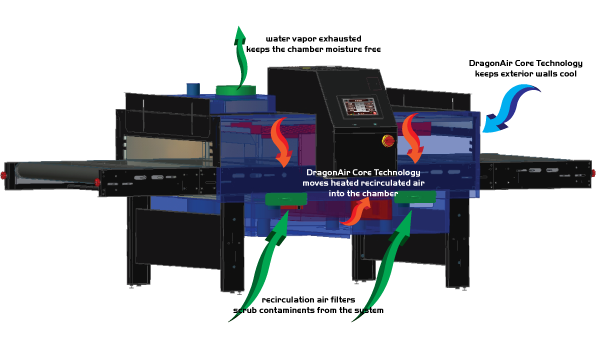
The DragonAir Core for this system features air that circulates within the heated chamber and is scrubbed with filters.  The water vapor is exhausted from the chamber to increase the cure rate.  Adjustable heaters allows for different substrates and different ink density.

TRX Main Running Screen
The software feature on the Fire is one that sets this apart.  
  • Storage of up to 36 production profiles
  • Touchscreen adjustment of all variables of garment cure
  • Analytics of production costs 
  • Storage of up to 18 maintenance tasks
  • On board diagnostics
  • much, much  more

DragonAir Crimson

DAC 2406 DragonAir Crimson
This baby dragon is new to the BrownDigital product line.  Offered with a 24" wide by 6' long belt, it can be expanded by adding additional chamber.   It offers the main feature of DragonAir Core Technology at a cost that is appropriate for smaller shops.  Hot air is recirculated through the chamber to cure both DTG inks and pretreat.  


Crimson Features include:
  • DragonAir Core Technology
  • Digital temperature control
  • 4" heat bump with temperature adjustment
  • Adjustable convection air

Is DTG for you?

So if you have one digital printer or many BrownDigital can improve your production flow with a curing system that is within your price range, production requirements and space restrictions.  Contact us to talk about which system is best for your bottom line.


Tuesday, October 15, 2019

DTG curing systems are different, and need to be.

Not your grandpa's t-shirt dryer

Digital printing is a specialty market requiring a new way of thinking.  Rapid production of low volume, high quality graphics is necessary to produce high profits.  The DTG printing process is different than traditional decorating.  The chemistry of the inks and pretreat require new curing temperatures and times.  They also need a different type of cure.  Traditional IR heat with a little moving air just doesn't do the job.  This technology is designed for plastisol and, though it can be used for DTG, it will not give the best results.

So what's different?


Let's start with pretreat.  What is it?  

Pretreat is a sticky liquid that mattes the fibers into the garment to create a flat, smooth surface for printing.  Most pretreat needs to be sprayed onto the garment and then heat pressed to get the best results.  This process is slow but effective.  Conveyor ovens, if designed for the job, offer a faster process with fewer operators.  Pretreat needs heat and air.  Evaporation is essential.  So, convection heat is optimal.  The garment still needs a 3 second press after exiting the oven to flatten the fibers.  What a convection oven offers is less standing around for the operator.

Now the ink.  Water based and white under base passes make this more complicated.

Water based inks need lots of air flow and time in the chamber.  Water is slow to evaporate and the chamber needs to evacuate the water without pulling out the heat.  Temperatures are lower than plastisol but times are longer.  Traditional ovens boil the water out with direct heat and evacuate the air with standard exhaust.  

The white under base, which can have multiple passes also needs to get the water evacuated.  This increases the time in chamber but the top color passes cannot handle the extra heat, so convection air is the optimal solution as the garment temperature stays more stable.

Why not use what you have?


You can.  And we sell ovens that will work if that is your best plan.  Yes, the TRX, the UltraSierra X-Series 2, the AirBlazer and the AirPony can cure DTG inks.  And they are a lower cost than ovens specific to DTG.  So if budget is a concern, our years of experience can help you use plastisol technology for your digital prints.  

However, we do not recommend them.  

Why?  You say.  No, it's not because we want to sell higher priced stuff.  It is because the technology to cure plastisol inks is not the same as the tech to cure digital inks.  Traditional ovens, like the ones we have been building for over 30 years, are great at what they are designed for.  They ramp the temperature of the garment up as they radiate heat directly onto the ink.  The ink does not need to evaporate, it needs to cure.  Plastisol inks, generally, require a cure at 320°F through the ink film.  As long as the full ink film gets to this temperature without scorching the garment, you can go as hot and fast as possible.  Once the plastisol hits temp, it becomes a solid sheet of plastic that is adhered to the garment.  So air is a nice feature to reduce hot spots in the oven or to force air into specialty inks like puff.  However, it is not needed for cure.

Options?

Gas ovens are a possibility for both ink types.  They are convection systems that sit the garment in hot air and evacuate smoke and steam.  However, in order to get to temperature, they need to be large.  Most shops do not have the space or budget for these ovens.  They also require a large power supply in addition to the natural gas connection.  In order for the garment to get to temperature quickly, they often have an IR bump in the beginning of the chamber and this requires 240V power.

So what do you look for?

Heated air, and lots of it that is contained within a closed system that scrubs and reuses it.  Another necessity is a quick blast of heat to bring the garment up to temperature quickly.  The fast temp bump will get the garment hot before it sits in the heated air which will speed up the cure time.  Additionally, that heat needs to stay in the chamber.  So cool external walls will keep the chamber hotter and the work environment cooler.

Digital temperature controls are essential.  Since garments are in the cure chamber for a longer duration than traditional curing, maintaining the top temperature will speed up cure and avoid scorching.  Digital controls maintain chamber temperature ±7°F and this will alleviate any cure concerns.  

Belt speeds that are slower than traditional plastisol cures are warranted as well.  Our pulse generators allow for belt speeds as slow as 99 minutes in the chamber.  Plastisol cures are 30 seconds to 2 minutes.  DTG needs 2 to 6 minutes depending on passes and the amount of pretreat.  

BrownDigital

DragonAir Core Technology

The DragonAir line of curing systems is designed for digital, water-based, plastisol, polyester, and specialty printing for fast paced, high production shops.  The DragonAir Core Technology™ ensures consistent and complete curing on all garments.

The new Crimson Dragon is designed for smaller shops with singular DTG devices.  The offer DragonAir Core Technology as well as digital temperature control in a compact footprint.  Priced for community printers, this allows a screen print shop to install a small oven just for DTG.  


The DragonAir Fire is for larger DTG producers who need additional belt space and are looking for higher end controls.  They feature TRX software for full control and storage of up to 18 separate garment profiles.

DragonAir Griffin systems are for full DTG producers.  Expandable and utilizing TRX software technology, these dragons give flexibility and durability for the ever growing digital market.

The FireFly is patented technology that goes one step beyond the Dragon line.  This revolutionary system will allow any type of garment to cure through any belt at any time.  Thermal imaging cameras monitor and adjust for each garment as it travels through the oven.

Not your grandpa's t-shirt oven because these are not printed on your grandpa's carousel.  Advancements in the industry push all of use to create new technologies to accommodate.  Look at your production facility and see if old school is still best.  It may be, or not.