Showing posts with label pretreat. Show all posts

Tuesday, March 18, 2025

DTF Production Systems


DTF Production

The garment decorating industry is at an accelerated pace for new technology and revitalization thru modification of old technology.  DTG launched the POD landscape that is now offered thru all levels of the supply chain.  Behemoth producers like Amazon and small community printers are adding POD tools to their production facilities to meet the consumer demand.  

The presentation of DTF into the production floor is not new, as all facilities have used transfers for decades.  However with the updated digital printing of these transfers this process has shifted many facilities to needing high volume DTF systems to fulfill orders.  

Brown Manufacturing offers 3 options for high speed DTF that will increase the speed of bulk orders with minimal labor costs. 

MasterPress

Level 1

The MasterPress is a base unit that features 2 heat presses and 5 shirt stations.  This allows 2 operators to load, press and peel in a small footprint.  Featuring a simple control panel and independent, adjustable temperature and pressure for the heat presses, this is a lower cost alternative for speed for the bulk DTF production.

Simple 120V power supply and a small air compressor is all this unit requires to quickly become operation in any shop.  Just map out spot on your floor and plug it in.

Level 2

If labor reduction is part of your production requirement, then the need for speed and accessories will move your shop to the next level.  Flexibility in design and additional options will amp up the production and reduce the operation to one person.

This heavy duty press comes with one heat press but has an option for two.  It also has these options:
  • Automatic feed system
  • Automatic peel system
  • DTG pretreat sprayer system
With one press, an auto feeder and an auto peel, the operator is only loading shirts.  With a larger unit, add a 2nd operator and the speed increases with one shirt load person and one shirt unload.  

Level 3

Design your own system for exactly the flexibility your shop needs.  This level allow the system to both DTF and screen print.  Add print heads, loaders, peeler, multiple heat presses, flash units and DTG pretreat sprayers all on the same system.  No matter the job needed, one machine will have the tools.

DTF Print and press
Which one is right for your production needs?  Contact our Brown sales team to plan out your improved production facility or call 616-249-0200 for immediate information.

Tuesday, July 18, 2023

Cleanliness is the first maintenance task for every machine

Our service department often is asked what the maintenance requirements are for any and all of the machinery we manufacture.  We appreciate machine owner's desire to keep their investment in peak condition for maximum production and long life.  For some of our products, the maintenance list is quite low as are the suggested stocking parts.  However, as the complication of the machine increases so does the upkeep. 

Many long standing customers will brag that they have kept their machines in proper working condition for 20+ years.  While this is a testament to the design and durability of these machines it is also a good determinate of the condition of the shop.  Well maintained, but could use some updating. So, as we do appreciate the compliments and understand the owners pride of ownership, there is benefit from keeping updated tools in your shop.

Returning to the question of maintenance requirements, as machines increase in complexity the list of daily, weekly, monthly and bi-annual tasks gets longer.  These tasks will be noted in the manual that is provided with the equipment.  If the machine is equipped with computers, then maintenance tasks are available within the software and reminders for mechanical maintenance can be preset.  The use of this software feature is very helpful in managing all of the essential tasks.  Some customers use this software to schedule additional tasks within the production floor for non-computer driven devices.

The number one maintenance task for any production floor is cleanliness.  

Textile decoration as an industry is inherently dirty.  The lint from fabric floats through everything and the production processes typically require liquids that are sticky.  So lint and fibers will get stuck to everything.  The lint will also adhere to any greased or lubricated surface of a machine.  And it will get pulled into fans, fan belts and chain drive systems.  So let's see chat about havoc that can create.

  • Electronics will overheat and malfunction due to clogged fans
  • Electronic connections will degrade due to lint interference 
  • Lubricated surfaces which allow for smooth machine movement will get clogged, affecting print quality and machine operation
  • Conveyor belts will wear faster and will transfer dirt and debris onto the final product
  • Registration and indexing systems will become inconsistent due to dirt and debris and this will affect registration
  • And machinery aside, what employee wants to work in a dirty shop.  And employees are a production floors most expensive and important asset.

How clean do we suggest?  Lint free is the key.

How do you  keep a garment decorating shop lint free.  You do it by making cleanliness a top priority on the floor.  Cleanliness makes for happier employees and fewer shut downs which will increase production and profits.

The good, the bad and the ugly.

Let's start with the simplest items, fan filters.  These are designed for easy on/off.  And they are used to keep the electronic cabinet fans clear of debris so that they can move cool air across the electronic components.


Then we can move to the fans.  Whether in the control cabinets or used to move air in and out of a curing chamber, they are essential to the design and function of your equipment.


Now what does all this do to internal components?  Electronic components shut down when they are too hot.  Being covered with lint will cause this.  Relays will fail, switches will stop communicating and thermal cameras will shut down.  Production stops.


What about the chassis and the mechanical items.  They appear to be pushing through but are they?  Or are you setting them up to fail?  And there are no GOODs here.  Seriously, yuck.


And what employee wants to touch these?  And if they do, how do they touch fresh garments and ship them completely clean?  

Ok, we think we have made the issue clear.

So this week, at the end of a work day, pick something and clean it.  Start with wiping down the outside, both the controls and the chassis.  Then get a vacuum and clean out the internal controls.  The whole job should take 20 minutes.  Then another day, pick another machine.  Go through the whole shop and clean everything.

Next time we will chat about those preset maintenance items available in your software.

Friday, August 13, 2021

So many decorating options.


Brown did some recent DTG print testing and I had some thoughts.  This particular test involved a print run of about 72 shirts ranging from youth medium to adult 3xl.  It has a white crest print and a multi-color full back on a dark shirt.  A typical order for a community printer.  And a profitable one if handled correctly for your shop.  

What is correctly?

DTG

This run was done with a digital printer and our Synergy pretreat and FireFly cure systems.  At 72 shirts with a white under-base, this job took almost 2 hours.  The image quality was fine but it did look like a digital print. They are clean but they do not pop.  The estimate on the cost of each garment includes time and materials.

Shirt $2
Ink $0.95
Pretreat $0.30
Shop time cost  $1.66
Labor $0.83

Total cost per shirt $5.74     

The positive to DTG  printing is that once the art is approved there is no additional processing of the art to print.  A quick conversation from the PNG and it is ready.  Also, employee training is minimal.  Everything is determined by the Linx program within the machines and the operator only loads and unloads.  Additionally, the software will resize the art to the size of the garment, the job is easily repeatable and there is no clean up at the end.


Screen Print on an automatic

So, what would happen if it were printed on an ElectraPrint auto press?  Front and back, this job would be finished in less than an hour.  The look would be crisp and it would pop off the shirt.  The size of the print on the youth would be the same size as on the 3XL, which is a negative.  There is set up and clean up.  The art needs to be separated and screens need to be made.  Presuming that this design could be printed with 6 colors, this is the estimated cost per garment.

Shirt $2
Ink $0.06
Films/screens $0.08
Shop time cost $0.83
Labor $0.42

Total cost per shirt $3.31


Screen Print on an manual

So, what would happen if it were printed on an MasterPrinter manual press?  Front and back, this job would be finished in about 2 hours.  The look would be crisp and it would pop off the shirt.  The size of the print on the youth would be the same size as on the 3XL, which is a negative.  There is set up and clean up.  The art needs to be separated and screens need to be made.  Presuming that this design could be printed with 6 colors, this is the estimated cost per garment.

Shirt $2
Ink $0.06
Films/screens $0.08
Shop time cost $1.66
Labor $0.83

Total cost per shirt $4.63 

Is cost the only factor in the production path?

Well, we can all say "no" to that answer.   But there is $2.50 per shirt here in profit.  So COGS cannot be ignored.

COGS is a significant factor.  That calculation has to include machine time, shop time and labor time.  However, judging the flow of your shop, the availability of your staff and their skill sets, and the print preferences of the final customer will sway the final production decision.   If they want "pop" then they will want screen print.  If they prefer a soft feel, then DTG is a good plan.

So the real answer is that there is not a "correct" way to do this except to follow some basic guidelines.

  1. Is the customer happy with the finished product?
  2. Did you deliver on time?
  3. Did you make a profit margin that you would want repeat the job?
  4. Did this job delay other jobs that were more profitable?
If your answers are yes, yes, yes and no, then you have chosen wisely within the parameters of your production facility.  If any other answer comes up, then reconsider for future jobs what needs to shift.  Was the print accepted, was job late, or did you not make enough of a profit margin?  Because in the end, it is a happy customer with a solid bottom line that we are all striving to achieve.


Thursday, January 14, 2021

DragonAir Crimson engineered for DTG production


We are SO EXCITED.  The DragonAir Crimson oven is fresh out of design and through production and is into DTG print shops throughout the US as well as globally.  Our engineering team dug deep to get this done and the design is a winner.  It addresses all the technical requirements for curing DTG inks and incorporates them into a machine constructed for low volume, high quality production.

Though small on size, this machine is packed with features that are essential. Direct-to-garment printing uses pretreat solution and ink that requires high volume air flow and stabilized heat.  In a short chamber, the garment needs an additional boost to get the cure needed.  These parameters were used to engineer this machine from the ground up just to meet the needs of DTG low volume production.

Major control features

DragonAir Crimson
The Crimson comes equipped with many features that professional DTG printers know are needed.  Starting at the control systems, this unit includes digital temperature control on the main chamber.  This reads the temperature at belt height and regulates cal-rod style heaters for optimal control.  These heaters are also have indicator lights for quick and easy verification of function.

Additionally, the Crimson includes a heat bump on the front of the heat chamber.  These quartz heaters are controlled separately from the main chamber and are monitored with indicator lights.  This allows rapid response to garment temperature requirements and quick heat build of product for faster production.  

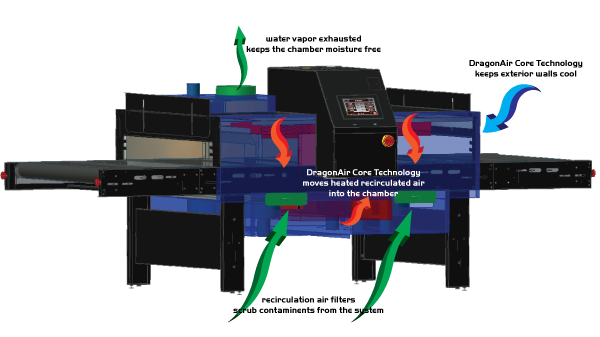
The air requirements of DTG inks are serviced by the variable air speed control.  DragonAir Core Technology circulates hot air around the heaters and onto the belt for rapid evacuation of water.  This air can be quickly adjusted to match a garment's specifications.  Also, the discharge from the garment can be funneled through the heavily insulated air box on the end of the chamber.  This is designed to connect to the exhaust system of a production shop and to contain the water vapor to exit from one location.


Construction features

The heat controls combine with a variable speed belt to give the operator a wide range of curing options.  This speed control is connected to a heavy-duty drive train designed with long lasting durability.  Crowned rollers making belt tracking simple and adjustable baffles are used to shield internal temperature from external influences.  All of this is packaged nicely on an industrial frame which requires minimal space.

The DragonAir Crimson is engineered specifically for DTG low volume production.  This small unit is the perfect  addition to any small digital facility who is ready to move on from using a transfer press for curing and is looking for a true DTG production machine.  

Wednesday, May 13, 2020

Linx software is a solution for production management

Orders come in and orders go out.  In many shops that means that there are pieces of paper following that order through all through the production process.  Some shops place those in plastic protective sleeves to keep them from flying about, but most just stack them on top of shirt piles and move them along with the goods.  With today's technology, why would anyone do that?  Because, it has always been done that way and it works.  Most of the time.

But there must be something better.


Ok, sounds catchy.  But what does it do?

Linx is a production management software that pulls orders from your online site, sends them to preset stations and pushes them into shipping.  The only thing that is printed is a barcode sticker that is attached to the garment.  It gives all departments including the artist, purchasing, production and shipping access to the order with the ability to sort all orders by the information that is relevant to that department.


The Linx app keeps all departments connected and can be integrated into most parts of the imprintables industry.  This system can be connected to DTG, laser engravers, plotters, and many other decorating operations.  

With this available, why would you want all that paper?


Friday, November 15, 2019

DTG curing for community printers

BrownDigital offers some amazing machines for large volume DTG producers.  Between the FireFly, the DragonAir Griffin curing systems and the Synergy pretreated production capacity is high and expandable.  These systems provide high quality finished goods as well as volume which have made them mainstays in these shops.

But what is available for the smaller or community producer who needs to be faster than a heat press allows?  Or one who would like to increase their quality to satisfy a higher lever customer?  BrownDigital offers curing systems for those DTG printers as well.

DragonAir Fire

DAF-3611 DragonAir Fire (aka Black Dragon)
The DragonAir Fire is offered in a 36" x 11' configuration.  Standard features include:

  • DragonAir Core Technology
  • TRX software for control of all curing variables 
  • Adjustable heater height
  • Adjustable convection air
  • Digital belt speed control
  • 8" heat bump with adjustable temperature control

DragonAir Core Technology 
The DragonAir Core for this system features air that circulates within the heated chamber and is scrubbed with filters.  The water vapor is exhausted from the chamber to increase the cure rate.  Adjustable heaters allows for different substrates and different ink density.

TRX Main Running Screen
The software feature on the Fire is one that sets this apart.  
  • Storage of up to 36 production profiles
  • Touchscreen adjustment of all variables of garment cure
  • Analytics of production costs 
  • Storage of up to 18 maintenance tasks
  • On board diagnostics
  • much, much  more

DragonAir Crimson

DAC 2406 DragonAir Crimson
This baby dragon is new to the BrownDigital product line.  Offered with a 24" wide by 6' long belt, it can be expanded by adding additional chamber.   It offers the main feature of DragonAir Core Technology at a cost that is appropriate for smaller shops.  Hot air is recirculated through the chamber to cure both DTG inks and pretreat.  


Crimson Features include:
  • DragonAir Core Technology
  • Digital temperature control
  • 4" heat bump with temperature adjustment
  • Adjustable convection air

Is DTG for you?

So if you have one digital printer or many BrownDigital can improve your production flow with a curing system that is within your price range, production requirements and space restrictions.  Contact us to talk about which system is best for your bottom line.


Wednesday, December 12, 2018

What an amazing year of innovation and learning


2018 has been an amazing year for Brown and BrownDigital.  It is difficult to list all of the changes that have occurred because it is not often that a company is cascaded with growth, innovation and industry accolades.    Our product lines continue develop and reach into new business sectors that originate within the garment decorating world but now sector off into many new specialties.  Our traditional Brown line has combined with the newer BrownDigital catalog to connect us with new people and our existing customer base with new advancements.

Since the screen printing sector of the industry remains strong, our ElectraPrint remains a solid base for our Brown product line.  The easy to maintain design, simple operation and durable construction  continue to make them a product of choice in the industry. It is always a pleasure to have a customer return to add another machine to their production line.

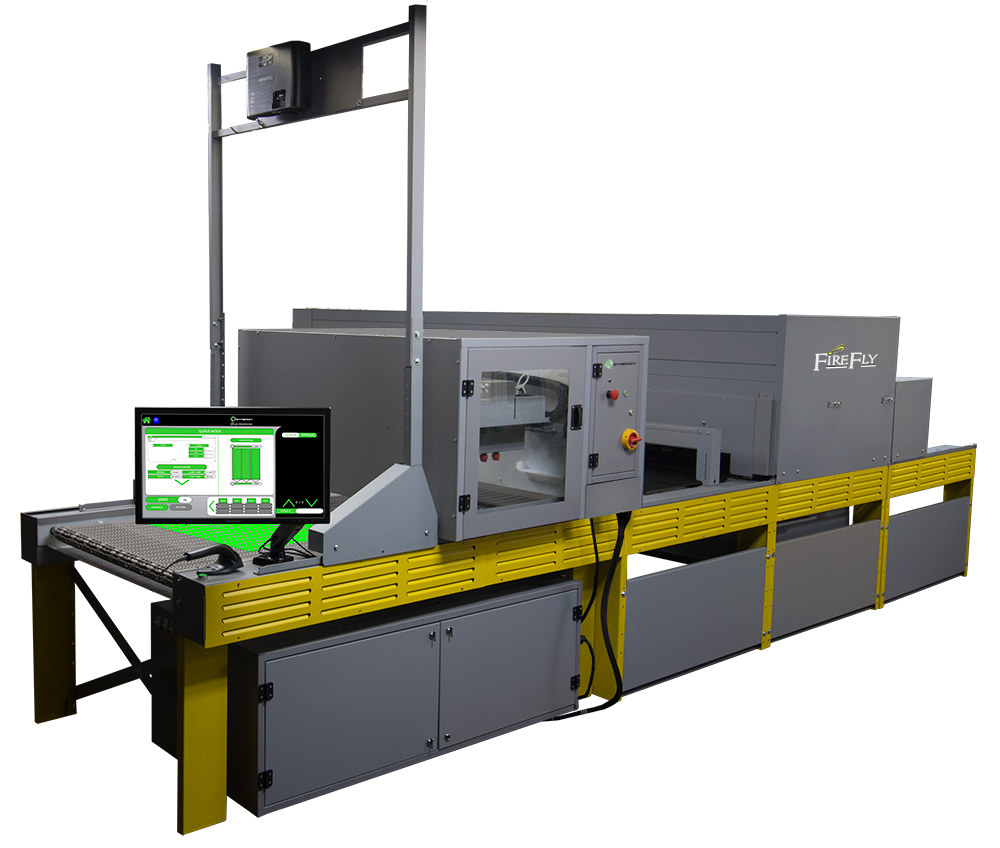
Many of these traditional printers are now expanding into the digital printing world and BrownDigital is there with solutions to these production issues as well.  The patented FireFly system is the technological leader for curing of both DTG and screen print inks.  The thermal imaging camera innovation sets this product apart from any other in its category.  This product saves space, time and energy while providing flexible curing for any garment at any time.   Combining the FireFly with the Synergy pretreat module adds another level of production control and  flexibility to any direct to garment printing operation.  This complete system is the reason for the expansive growth and reach of new markets that we have enjoyed in 2018.

The pinnacle of this is the SGIA's prestigious Product of the Year awards.  Brown Manufacturing Group is honored to have earned these award for 2 years running.  We show distinction in curing, pretreat and combination systems that cover an array of production variables.  What is still more exciting is that our engineers have more innovations ready for to present for this award next year and still more to come.  The buzz of ingenuity in our office is energizing.

So thank you to our loyal customers for their continued support of the Brown screen printing product line.  We see this part of the garment decorating industry to remain an elemental part of our business for years to come.  And, to our new DTG customers, welcome to the Brown family.  We look forward to continued success and connections within all sectors of our industry in years to come.


Monday, November 5, 2018

Our industry is unique, and challenging

I met a friend for cocktails this weekend and we discussed our careers and the industries that we are in.  This person had a recent job change and was describing the differences in the two markets.  While chatting, the question came up, "Why is printing on a t-shirt so hard?"  It occurred to me then that what we do is truly unique.  In most industries the production variables are limited and consistent.  The "how to" is measured and analyzed with tolerances defined and universal industry standards measured.  Well, anyone who has printed garments knows that most of this does not apply to us.

Sure we have defined cure temperatures for ink.  Sure we have PMS color matching.  And, of course, we have production rate requirements.  But even all of this is loosely followed.  Ink cure temperatures rates vary by brand and type.  PMS colors are borrowed from other print industries and are loosely applied to color cards from ink companies, though many shops do have custom ink mixing in house.   As for production rates, we are all trying to produce a profit.  And that need drives everything.

So my companion currently sells high end cars and used to sell real estate.  Market and economy fluctuations are what drives these industries.  In the metal fabrication business, metal is systematically measured and variables in quality are based on the human factor.  The inkjet, laser and DTG printers that surround my desk are all assembly line production items as is the laptop I am writing with.  So I explained all of the options within production and sales of printed garments and I mystified myself with questions of how we do it all.

Let's go over the list.

  • Every garment type is different:
    • color
    • fabric
    • weight
    • pile
    • construction
  • Every individual garment may be different:
    • size
  • Every ink type has a different cure temperature and that is influenced by:
    • thickness of the ink film
    • thickness of the garment
    • number of layers of ink film
    • time in the chamber
    • temperature of the chamber
    • air flow of the heat chamber
  • Each artwork file has it's own printing parameters
    • size
    • number of colors
    • type of separation
    • what color it is to print onto
  • Type of printing influences or is influenced by all of the above
    • Manual screen
    • Automatic screen
    • DTG
    • Sublimation
  • DTG variables include
    • pretreat type
    • pretreat density
    • pretreat cure
I have only scratched the surface of what can happen in a day.  So what do you do?

You can go old school.  And it works.  

Log books, spread sheets, paper pick tickets with instructions, even sharpie marker notes on the machinery can help limit issues.  As an example, a pick ticket should include order information, cure settings, pretreat requirement, ink colors and color order.  This is a solid system that works most of the time and is historically reliable.  

Now let's move that to today's technology.  


Digital resources make it possible to put every piece of information in one storage location and link all that together by all the variables.  This can all be put on a mobile device at each production unit that can reference the information by scanning a barcode.  This technology is used in most production industries today and, because of all of our variables, should have been in garment decorating years ago.


A previous blog was written on our Linx software.  This system manages the information on all of the variable that are listed above.  Once information about a type of garment are input into the data base then that information is linked to any order that needs that garment.  It stores artwork files and connects them to orders.  It controls curing and pretreat parameters in the Synergy and FireFly.  It can track orders through production and connect them to ShipStation.  This tool helps to contain the chaos that is elemental to garment decoration.

So, though the cocktail and conversation was a wonderful way to catch up, my companion decided that what I do is crazy talk and selling Porsche and Bentley are a better fit.


Monday, December 11, 2017

2017. A year of innovation.


What an amazing whirlwind of a year.  New technology and innovation moved Brown and BrownDigital into new segments of the garment decorating industry.  This addition brings new energy and enthusiasm to existing projects as well.

So what's new?

That's a big question.  Around our facility it feels like everything is new.  New curing systems, new printing technology and completely new product lines.  

Expanded Anaconda™

The Anaconda system is a flat heater that combines with a roller in an automatic printer to flatten fibers into ink to create a smoother print surface and, hence, brighter prints.  Originally, this was developed to use a 23" x 31" M3 roller frame support platform to fit into an standard automatic textile printer, like our ElectraPrint Stealth.  The excitement for the Anaconda has grown and we expanded the possible press sizes for it.  Now it can be mounted on a 21" x 24" MZX roller frame support which allows it to fit into smaller automatic presses like our ElectraPrint Junior.

The creativity of our customers as to how this product can benefit production is exciting.  We see the Anaconda applied to prints on polyester with dye migration issues, on water base or discharge inks to activate the cure and smooth out the print and on fibrous shirts for a crisper finished print.  The options are exciting.

Synergy™ pretreat system

BrownDigital moved deeper into the world of direct to garment printing.  The Synergy pretreat module system is a high production pretreated that ties directly into the FireFly™.  This unit offers more features and sprays pretreat more evenly and at higher speeds than competitive machines.  The exciting connection to the Brother GTX line of printers allows for pod style production growth with minimal labor costs.  Check out our recent blog about these pod systems.

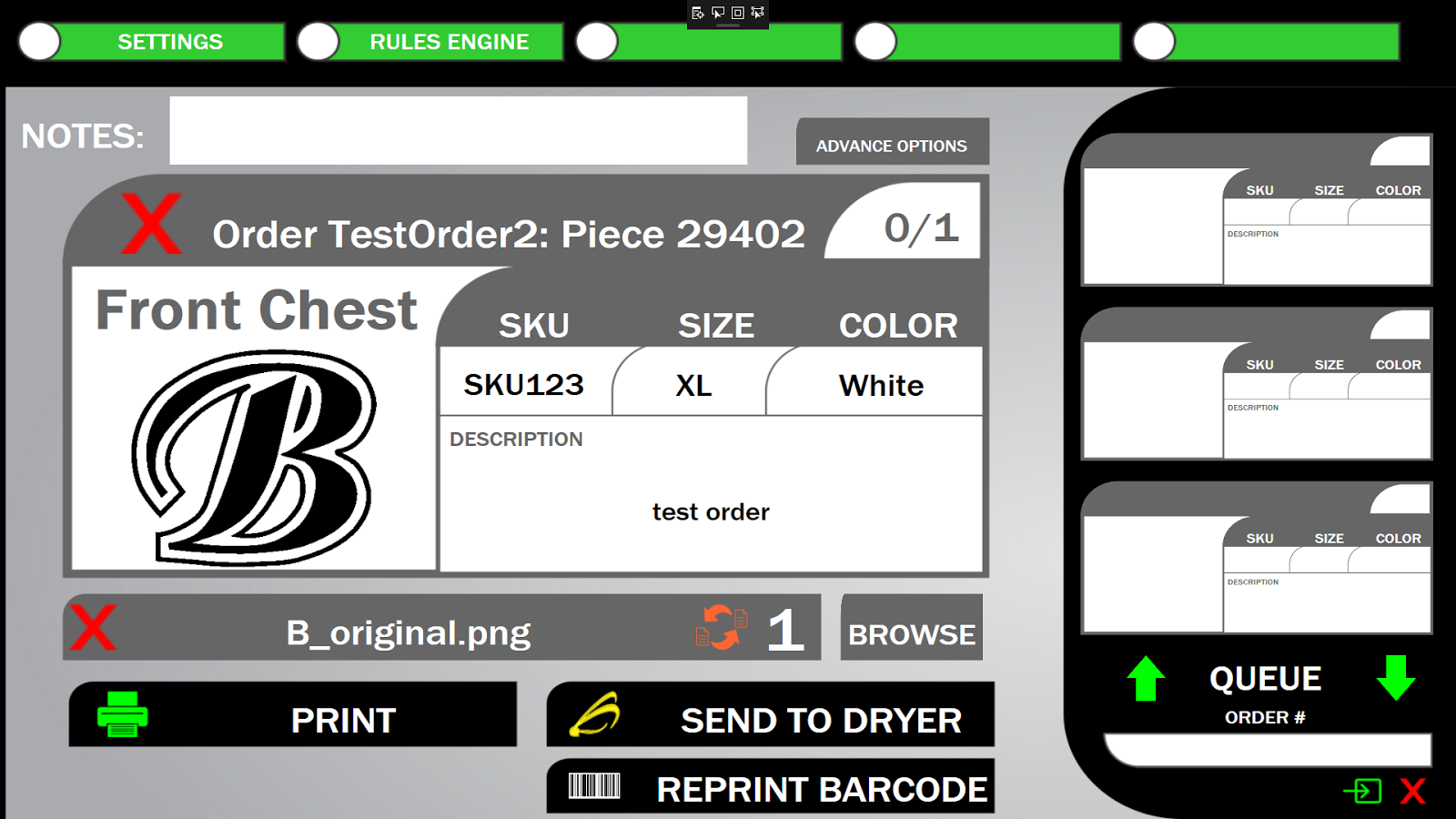
This system also puts more information in front of the garment loader.  There is always a concern that what is pretreated is not the correct garment for the required order.  The projection system that is included with the Synergy displays an image of the shirt required and the image that is to be printed.  This gives confirmation to the operator that the are loading the correct product.  Features like this make this the leader in pretreat technology.

Linx™ Control System Integration

What is Control System Integration?  It is complete production software that ties your orders to your pretreat, digital printer and shipping software.  A barcode control system allows for inventory control and complete tracking of goods within your production facility and into shipping.  This product has quietly expanded and is running in facilities throughout the US.  BrownDigital views this as an essential component to online sales and digital printing.  This is a lead off for 2018 and it is an exciting direction for our corporate growth.
Brown Mfg and BrownDigital are looking forward to 2018.  The expansion of market areas from our existing product line and the development of new items is exciting.  Keep watching this blog for updates.  


Tuesday, November 7, 2017

Synergy pretreat in action

In our last blog we introduced the Synergy™ Pretreat Module.  This was presented at SGIA and combined with the Brother® GTX direct to garment printer.  This combination allows for versatility and speed for any medium to large production shop.


Synergy + Firefly All-In-One Production System from Brother DTG on Vimeo.

If you have additional questions about the specifications of this system or how this might also work on any different brand of digital printer, contact our sales department at sales@brownmfg.net.

You can also look at our BrownDigital web site.  www.brownmfgdigital.com

Tuesday, October 24, 2017

Synergy™ pretreat module offers speed and growth


Ok, so this is what the word means but ....?
SY36x84 Synergy with FY2x36-45 FireFly

Combine the FireFly™ patented technology in curing inline with BrownDigital's new high volume pretreat module, Synergy™, and the production rates go up while the labor requirements go down.

The Synergy™  Industrial Pretreat Module is designed for high volume digital decorators and connects directly to the FireFly™ curing system, allowing for rapid evaporation of pretreat solution and a quick turn around to the digital output device.  The flow of the operation continues with reverse transport of the garment back to the original operator.  Complete multi-variate control of each garment.

Pod systems for production allow for flexibility.


Using the production flow shown, two operators can process the full operation.  One person is the pretreat loader and the final product packager.  A second person runs 4 Brother GTX machines.  High volume, low operating cost.

90-150 units per hour


Pod designs can scale for additional production.   

240-300 units per hour

450-600 units per hour 


Speed and flexibility with minimal personnel make the Synergy and FireFly combination a must have for those shops who need to step up their direct to garment volume.